Parliamentary attention to climate change remains largely event-driven and reactive, with major disasters and extreme weather prompting brief spikes in debate rather than sustained scrutiny, finds the Cenfa report.
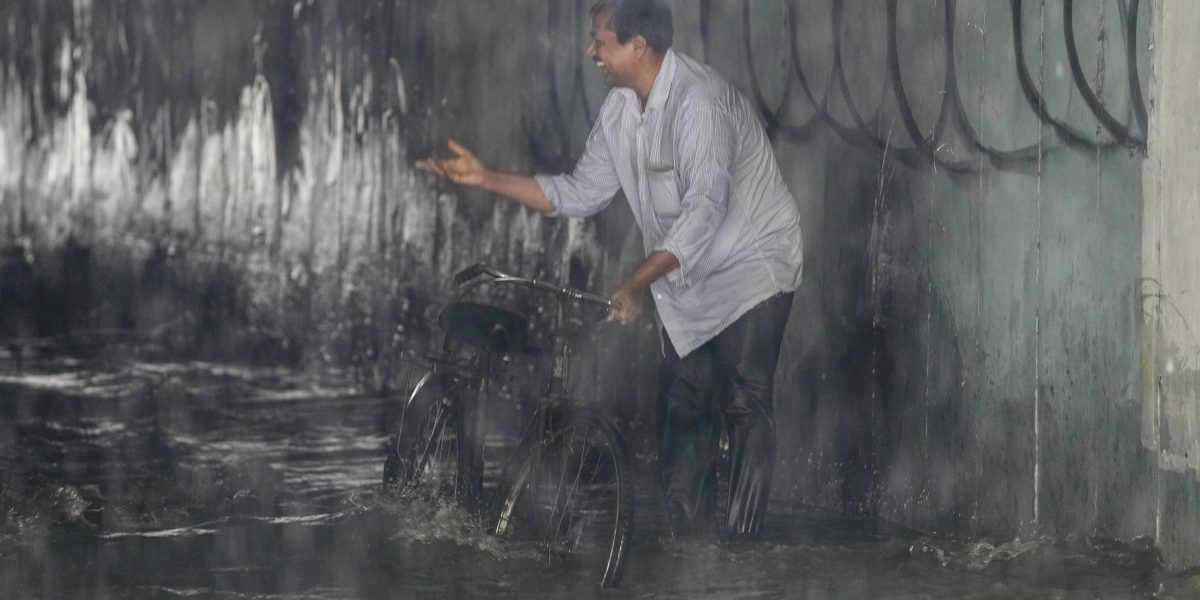
Rainfall in Delhi leaves a man stranded. Photo: PTI/Ravi Choudhary.
New Delhi: A new report based on questions asked and answered in parliament as well as parliamentary debates spanning a decade since the Paris Agreement in December 2015 was released on Thursday (October 1). The report, “Climate on the Floor: India’s Parliamentary Discourse on Environment since the Paris Agreement”, finds that there has been little debate in parliament despite ten years since the landmark agreement.
“The concern around the environment and climate today is much greater than it was ten years ago. Yet there has not been much debate in Parliament despite ten years of the Paris Agreement,” said Jairam Ramesh, Member of Parliament and former Minister of Environment, Forest and Climate Change, Government of India, while releasing the report.
The report was prepared by Hajira Puthige for the Centre for Financial Accountability (Cenfa). A total of over 8,700 climate related questions and debates were scanned as part of the research effort. The report finds that climate change remains a relatively small component of the national agenda, accounting for just 3.3% of all parliamentary questions asked over the decade.
“The findings of the report are startling because just in the first nine months of 2025, 4,064 lives were lost to extreme weather events in India, marking a 48 per cent rise in deaths over the past four years,” said Hajira Puthige, author of the report.
He highlighted a joint report by the Centre for Science and Environment and Down to Earth which said that these adverse events affected 9.47 million hectares of crops, destroyed nearly 100,000 houses and killed approximately 58,982 animals.
“The human and economic toll was not confined to a handful of isolated disasters: at least 18 states and Union Territories recorded their highest number of extreme-weather days since 2022,” Puthige said.
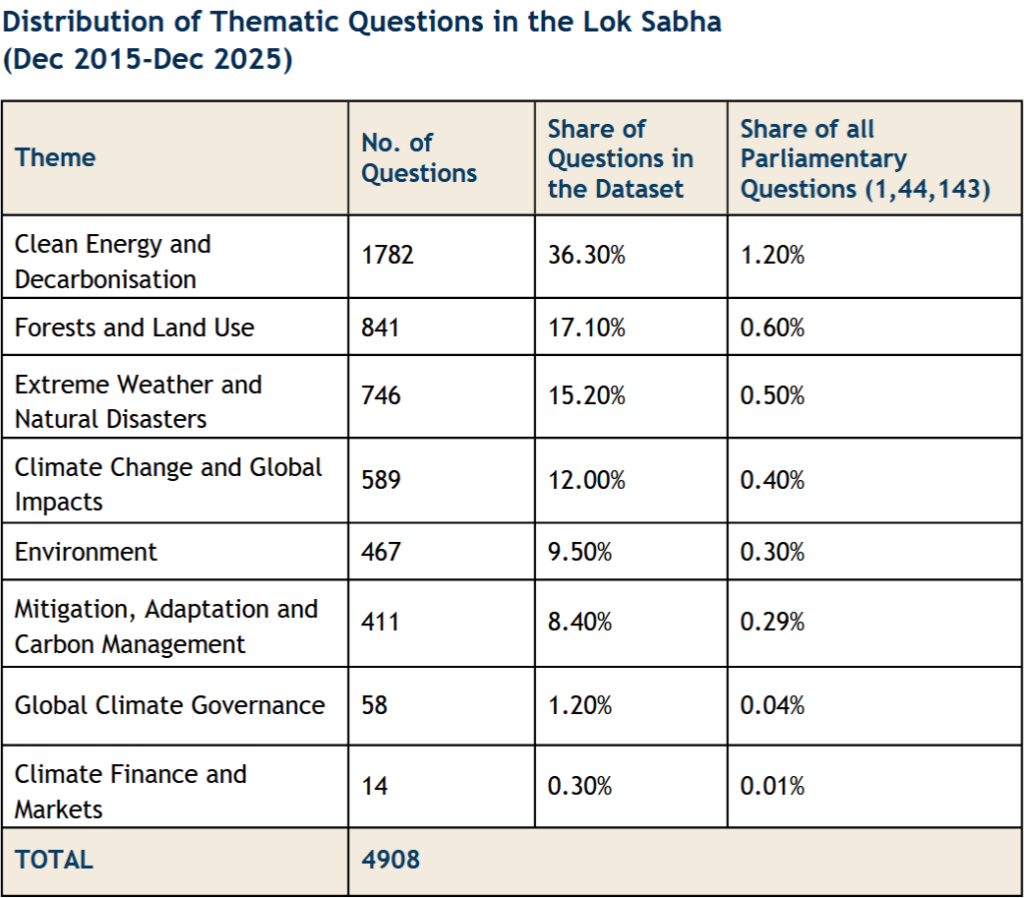
Source: Cenfa’s report, “Climate on the Floor: India’s Parliamentary Discourse on Environment since the Paris Agreement”, 2026.
The analysis reveals a clear partisan pattern in the parliamentary questions, says the report. While Members of Parliament from the ruling NDA tend to predominantly ask status-oriented questions in parliament that provide the government an opportunity to celebrate its programmes and offer technical updates on missions such as PM-KUSUM or “Green hydrogen“.
In contrast, members of the opposition parties tend to focus on implementation gaps, funding shortfalls and policy effectiveness. The Executive frequently invokes the federal shield, deflecting responsibility for disaster relief, urban flooding and forest management to state governments by labeling them as “state subjects”.
A data blackout often acts as a policy shield, with the government stating it does not centrally maintain data on climate-induced migration, heatwave deaths among informal workers or the exact forest area destroyed by wildfires.
While there is legislative interest, it is heavily concentrated on Clean Energy and Decarbonisation (37.7%), which aligns with prestige-heavy international targets. Conversely, Climate Finance (0.3%) and Global Climate Governance (1.3%) are significant blind spots.
The research also found that the National Adaptation Fund for Climate Change (NAFCC), once a flagship for vulnerable sectors like agriculture, was downgraded and reclassified as a “non-scheme” expense from FY 2023–24, and no new projects were to be initiated under it.
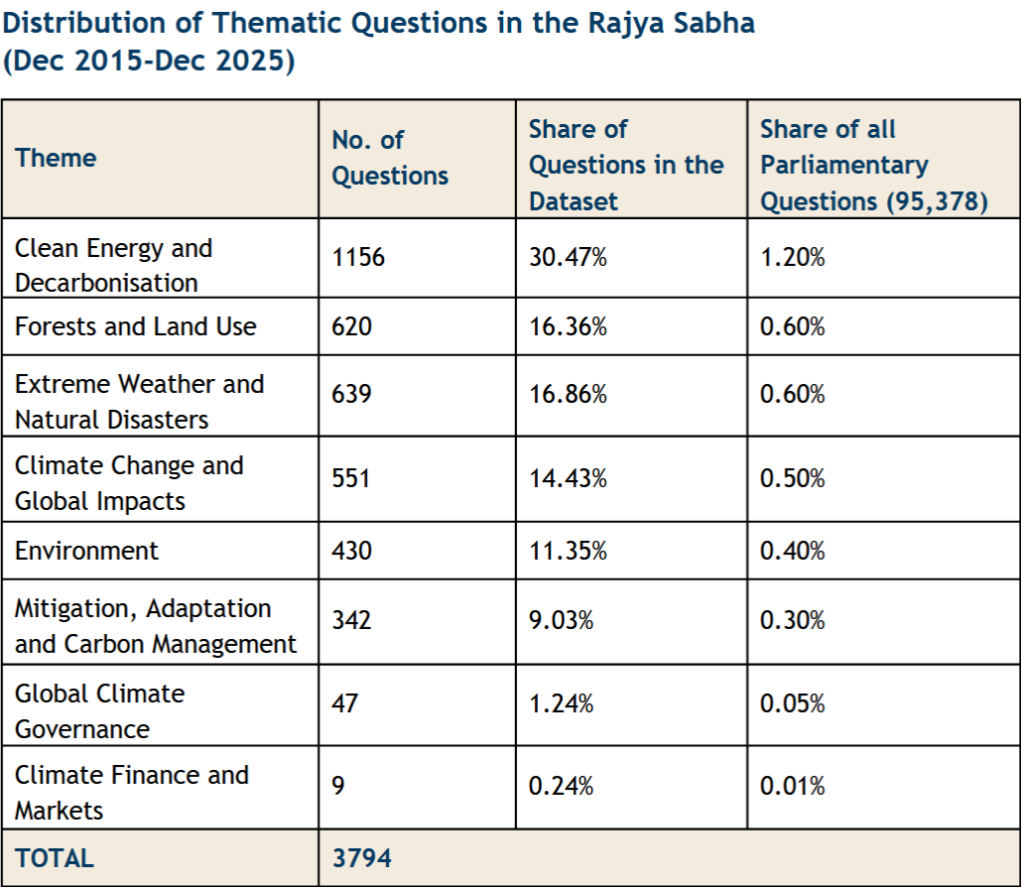
Source: Cenfa’s report, “Climate on the Floor: India’s Parliamentary Discourse on Environment since the Paris Agreement”, 2026.
Legislative attention predominantly seems to be event-driven and reactionary rather than strategic. For example, the February 2021 Uttarakhand glacier burst forced a spike in questions concerning glacier melt and cloudbursts, while the record-breaking heat of 2022 marked the first substantial parliamentary focus on heatwaves, previously a deadly hazard blind spot.
The government consistently prioritises technological optics, such as the Flood Watch India App and the Van Agni portal, as evidence of action. Yet, it often lacks operational benchmarking; for instance, the Ministry has admitted to having no nationally benchmarked firefighting systems despite tracking fires with satellite precision.
This article was originally published in The Wire you can read it here.