
The World Bank Group’s (WBG) engagement with India is among its largest and longest running country programmes. Its current portfolio as of December 2025 comprises 75 active lending projects with commitments of around $17.8 billion, making India the Bank’s largest borrower. However, the significance of this historic relationship cannot be measured through lending volumes alone. It must be understood by the far-reaching impacts of the Bank, its prescriptions and investments. Over its eight decades of engagement in India, the WBG’s has exercised immense influence over India’s development trajectory, national policies and governance structures.
This article looks at the World Bank’s approach to accountability and analyses how, as its modes of intervention expanded, the points at which accountability could be identified and contested also shifted, thus further eroding it to the detriment of affected communities.
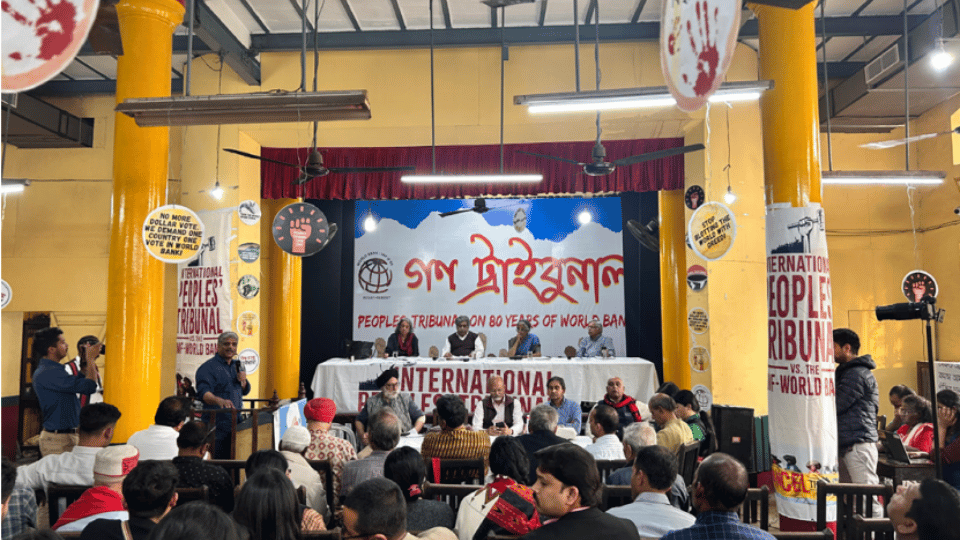
At the end of 2024, as the World Bank and the IMF commemorated their 80th anniversary, over 300 people held a People’s Tribunal in India to examine the institutions’ legacy on people, the environment and the economy. With over 30 depositions from experts, projectaffected communities and civil society organisations – and building on a similar tribunal held two decades earlier in New Delhi in 2007 – what emerged was evidence of the Bank’s perpetual evasion of accountability and its invention of newer investment mechanisms, which blurred transparency and further eluded people’s efforts to hold them accountable.
This history of resistance can be traced to the early decades of the Bank’s engagement in India – from the late 1960s when then-Bank President Robert McNamara was prevented from exiting the Kolkata airport, where he was on an official visit, after protesters gathered to oppose the Bank’s role in the country. Decades later, sustained mobilisation by Adivasis, farmers and other impacted communities forced the Bank to review its lending to the Sardar Sarovar (Narmada dam) Project, which eventually compelled it to establish the Inspection Panel in 1993, the first accountability mechanism in any multilateral development bank. The sustained pressure and demand for accountability eventually led the Bank to cancel the loan after the project’s social and environmental harms became impossible to disregard.
Two decades after the Bank withdrew from the Narmada dam project, communities affected by finance from the International Finance Corporation (IFC), the Bank’s private sector arm, for the Tata Mundra power plant, under the aegis of Machimar Adhikar Sangharsh Sangathan (Association for the Struggle of Fisherpeoples’ Rights) sued the IFC in the United States, which resulted in the US Supreme Court ruling that the World Bank Group does not enjoy absolute immunity.
While responses to these two projects are landmarks in people’s efforts to hold the Bank accountable, there were several other projects in India where project-affected communities and civil society groups were compelled to engage with the Bank through its accountability mechanisms and in public advocacy over serious project impacts. These include the Lafarge mining project in Meghalaya, the Vishnugad Pipalkoti7 and Allian Duhangan8 dam projects in the Himalayas, the Mumbai Urban Transport Project,9 and water privatisation in Madhya Pradesh. This is in addition to a large body of work exposing the Bank’s interference in the power, education and health sectors in India, all of which were privatised, making it difficult for the common people to afford essential services.
Historical evolution of World Bank in India
Over its eight decades of engagement in India, the WBG’s approach has evolved from direct lending for infrastructure projects in the early years of independence to what is today known as the ‘Finance+’ approach, through which the Bank has exercised immense influence over India’s development trajectory, national policies and governance structures. As the Bank’s modes of intervention expanded, the points at which accountability could be identified and contested also shifted.
The first phase of intervention from 1948 to 1970 saw the Bank’s engagement primarily rooted in direct lending for infrastructure development, broadly in line with India’s Five Year Plans. From the 1970s, as India dealt with a food sufficiency crisis, funding for agriculture expanded through irrigation and rural credit. A shift, however, occurred in 1958, when the Bank moved from direct project lending to coordinating multilateral assistance through the Aid-India Consortium during a balance-of-payments crisis. This marked the start of the Bank’s direct involvement in discussions about India’s economic performance, policies and development priorities and laid the foundations for its expanding policy influence in the subsequent decades.
The second phase spanning the 1980s and 1990s saw a shift and consolidation in the Bank’s own institutional positions, which increasingly reflected a belief that state-led development and industrialisation were themselves the main obstacles to growth. The World Bank and IMF articulated this shift through the Washington Consensus, which called for fiscal austerity, trade and financial liberalisation, deregulation, privatisation and an overall retracted role of the state in the economy. This vision was operationalised through the Structural Adjustment Programs (SAPs). In India, attempts at this were pushed throughout the 1980s by easing import restrictions, industrial delicensing, etc., before finding full expression in 1991 when a balance of payments crisis and related IMF loan forced the country to accept adjustment as the price of assistance was dependent on restructuring the economy through the New Economic Policies.
However, economists have argued that these reforms were not an unavoidable response to the collapse of the earlier economic system but rather an ‘opportunity’ for the IMF, World Bank and certain Indian political and business interests to restructure the economy in favour of markets and global finance. Although the SAPs were eventually phased out, they left behind a lasting template that continues in different guises but operates through similar conditionalities that continue to limit state sovereignty and policy space. This template has also given an increasingly pro-corporate and authoritarian Indian state a rationale for deregulation, privatisation and other policy measures that have undermined the public interest, exacerbated inequality, weakened public institutions, restricted access to essential services and contributed to environmental destruction.
The expansion of policy influence was also met with an expansion of resistance. During this period, as the Bank was consolidating its influence in India and, influenced by the ideas of transparency and accountability that were taking hold globally, India saw the proliferation of people’s movements centred on rights, identity, displacement and environmental justice emerge partly in response to the economic reforms and the rising critique of growth, as opposed to people-led development. It was under these conditions that the Narmada Bachao Andolan brought the demand for accountability directly to the World Bank, pushing the Bank to establish the Inspection Panel. While these mechanisms have scope for considerable improvement, their creation reflected an acknowledgement of the harmful consequences of the Bank’s intervention and an attempt to embed at least some measure of accountability into its institutional architecture.
Expanding influence
With more private capital flowing into the country following economic reforms, a new dimension of the Bank’s lending and engagement began to emerge. Into the early 2000s, the Bank recalibrated its approach in response to growing resistance and began to move away from financing large scale infrastructure projects towards state-level sectoral reforms and private sector models of development, including the privatisation of state electricity boards and the introduction of ‘user charges’ under public-private partnerships (PPPs) for water and sanitation. At the same time, the Bank encouraged greater privatisation of other essential services like health and education. In the last two decades, the private sector has come to dominate these sectors in India. This model of development, encouraged by the Bank and the IMF, has allowed the Indian state to dilute its responsibility to provide universal, accessible and affordable basic services and arguably to avoid its legally binding human rights obligations.
The shift in the locus of influence from financing specific projects towards reshaping sectors and institutions also changed how and where accountability could be sought. As implementation moved through various state and non-state actors, the consequences of the Bank’s role became difficult to trace. Years later, the Bank consolidated its position as a ‘knowledge bank’ under its Finance+ approach, where it has played a critical function in shaping national policies through advisory services and technical assistance. Ideas such as asset monetisation and disinvestment through the sale of publicly owned assets to raise money were pushed by the World Bank into Indian policy discourse. Its investment strategy has also evolved towards policy reform linked lending, as seen in Development Policy Loans (DPLs), which tie loans to specific sectoral reforms.
Another visible change has been the growing involvement of the IFC and the increasing mobilisation of capital through private financing. India is IFC’s largest client country, with over 250 projects and $8.9 billion in investments across infrastructure, energy, housing, technology and finance. These two shifts, the Bank’s expanding role as a knowledge institution and its growing reliance on private financing, are deliberate and mutually reinforcing. Its advisory work has helped restructure India’s economy to make it more accessible to markets. It is well established that the IFC’s financing model prioritises financial viability over genuine outcomes, with investments designed to minimise risks for lenders and investors, while the social, economic and environmental costs are borne by the people. For accountability, this has meant that the Bank can continue to exert significant influence through policy advice while increasingly enabling it to distance itself from both direct and indirect harms.
While some of the more recent writing within the World Bank and IMF recognises the limitations of earlier neoliberal measures, these shifts in rhetoric have not led to any break with the underlying neoliberal model of development. This remains evident in the Bank’s current Country Partnership Framework for India and its emphasis on private sector driven growth and employment, where the role of the state is defined less by shaping growth choices and more as an instrument to implement regulatory reform and de-risk certain sectors to make them more investible for private capital.
The accountability question
As the nature of the Bank’s intervention has changed, so has the question of accountability. The Finance+ model does not just weaken accountability in practice; it actively reorganises financial flows in ways that systematically diffuse it. The Bank’s accountability architecture was built for an earlier iteration of the World Bank – while the Bank has changed, its understanding of accountability has not.
It is important to distinguish between genuine accountability and the role and scope of multilateral development banks’ independent accountability mechanisms. The Inspection Panel and the IFC’s Compliance Advisor Ombudsman (CAO), at best, respond to complaints concerning direct and identifiable harms linked to specific Bank-financed activities. Their mandates depend on harms being visible, attributable and traceable, which is precisely the conditions that indirect financing, financial intermediation and DPLs obscure. The Inspection Panel cannot initiate an investigation on its own, while the CAO has rarely exercised its limited suo motu authority. Proactive accountability is therefore structurally constrained even where harm is serious, foreseeable and widespread.
The Tata Mundra case exemplifies these limitations. After 14 years, and despite damning findings, the CAO closed the case without securing any remedy for fisher communities, who continue to face economic, social and cultural losses, while the IFC and its private partners bear minimal losses and no accountability. Even where accountability mechanisms are available, they are limited to only seeking remedy after harm has occurred, while communities most impacted by these development choices have little meaningful role in planning and making decisions that produce the harm in the first place.
More importantly, this framework is incapable of addressing indirect harms arising from the Bank’s wider developmental model. Debt dependency, the consequences of DPL conditionalities, widening inequality, deteriorating labour conditions, the privatisation of essential services and cumulative environmental destruction emerge across multiple loans, advisory interventions, regulatory reforms and private investments over time, placing them beyond the reach of existing mechanisms.
Therefore, the proposed consolidation of the World Bank Group’s IAMs must be seen in the context of this widening accountability gap, with the merger proposed at the same time as capital is increasingly privately organised and accountability intentionally obfuscated. The merger is merely administrative and does not address the structural weaknesses of the existing system. Instead, it risks weakening the few avenues currently available to impacted communities. Harmonisation of the IAMs into a single framework risks diluting the positive aspects of the differentiated mandates, procedural strengths and institutional autonomy, reducing both to the lowest common denominator in the name of efficiency thereby serving the Bank’s underlying intention of limiting accountability, rather than strengthening it.
Ultimately, the Bank’s policies and the accountability debate must be located within its fundamentally unequal structure, where dominant shareholders, largely from the Global North, shape development trajectories in line with their economic and geopolitical interests and those of private investors, forming a part of a wider neocolonial structure.31
Merging two weak, undervalued and overlooked mechanisms into one will not make them stronger or more effective. An effective accountability mechanism requires a clear mandate, adequate power, institutional independence, and sustained political commitment to ensure that it can perform its functions credibly. The question is not just whether the Bank has an accountability mechanism, but whether its accountability framework is able to account for the changing ways in which the Bank exercises power and shapes development outcomes.
The article appeared in a special issue titles “ The Bretton Woods Institutions in Asia: Exploitation, path dependencies and persistent contradictions” by the Bretton Woods Project, launched ahead of the 2026 World Bank Annual Meetings in Thailand. You can find the full report here.