
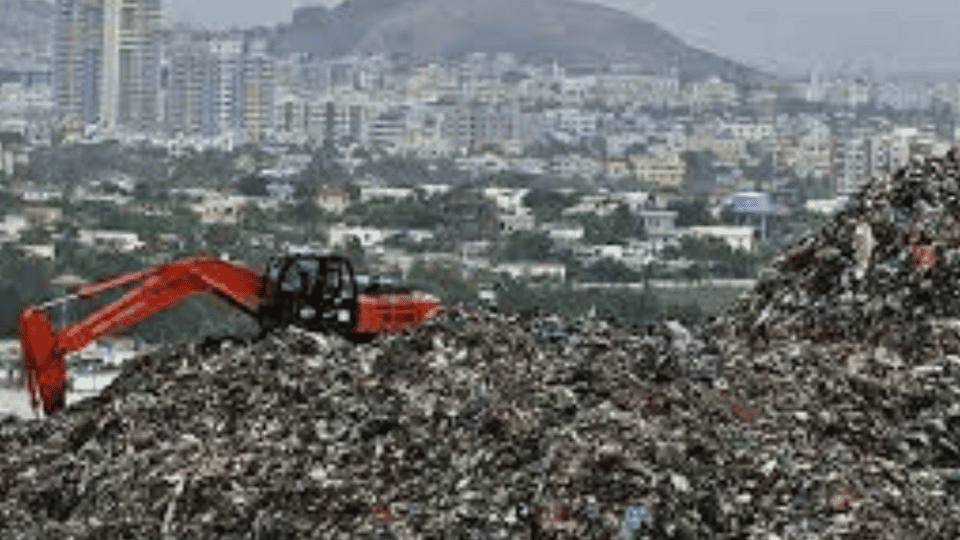
HYDERABAD: A new report has found that electricity from Delhi’s waste-to-energy (WTE) incinerators produces more carbon emissions than almost any other source in India. Activists in Hyderabad say these findings should make Telangana reconsider its plan for a large new waste-management facility at Siddapur.
The study, The Climate Cost of Burning Waste, was prepared jointly by the National Alliance for Climate and Ecological Justice (NACEJ) and the Centre for Financial Accountability (CFA). Specifically, it estimates that Delhi’s four working WTE plants release 3.4 kilograms of fossil-based CO₂ for every kilowatt-hour of electricity they provide. This is about 4.7 times more than the Indian grid average and 3.5 times more than coal, according to the report.
Hyderabad at the centre of the problem
Campaigners say Hyderabad’s own experience shows the risks of burning waste. For example, satellite data analysed by the University of California, Los Angeles (UCLA) and Carbon Mapper found that the Jawaharnagar landfill gave off methane at 5.9 tonnes per hour in 2025. This made it the top methane emitter in India and the fourth highest in the world among waste sites studied in April 2026.
Overall, these findings suggest that Hyderabad’s WTE incineration model is not working well. They raise doubts about using incineration as the main solution for the waste problem, especially while organic waste keeps piling up and breaking down.
Civil society groups and residents around Jawaharnagar have also raised concerns about fly-ash disposal, leachate, groundwater and soil contamination, and the adequacy of pollution monitoring. In response, a joint fact-finding exercise in 2025 documented these community concerns. The Central Pollution Control Board (CPCB) found cadmium in fly ash from Jawaharnagar at 850.65 mg per kilogram, far above the safe limit of 0.8 mg per kilogram, over 1,000 times the limit. In Dundigal, the level was 956.69 mg per kilogram, almost 1,200 times the CPCB limit.
Questions over Siddapur
Environmental activists say these findings raise serious doubts about Telangana’s plan for a 4,000-tonne-per-day waste facility at Siddapur. They question whether the State is solving the real causes of its waste crisis or just continuing to rely on burning waste in large plants.
The four plants burned 735,840 tonnes of plastic in 2023, about 2,016 tonnes per day. Furthermore, the report says plastics made up about 42% of their fuel by weight. Burning these plastics released an estimated 2.1 million tonnes of fossil-based CO₂, which is similar to the yearly emissions of 1.44 million cars. However, the plants only provide about 198 kilowatt-hours of electricity for each tonne of waste they burn, meeting less than 1.5% of Delhi’s electricity needs.
Importantly, the 3.4 kg number only counts CO₂ from burning plastics, not the total impact. If you include all emissions from burning both fossil-based and natural waste, the total could be about twice as high.
The report also criticises India’s Extended Producer Responsibility (EPR) system. This system lets WTE incinerators earn certificates for burning plastic, rewarding burning instead of reducing, reusing, or improving packaging. It also points out that in 2025, the CPCB put WTE incineration in a “Blue Category” of important environmental services. A different CFA rating gave Delhi’s four plants a Pollution Index of 100 out of 100, which shows pollution risk but not climate impact.
The report recommends that municipal waste incineration should not be funded as a climate-friendly solution, even for new or expanded projects. In addition, it says carbon credits for this kind of incineration should stop, and the Clean Development Mechanism credits should be reviewed. The report also asks to remove mixed municipal waste incineration from renewable energy and “Blue” categories, and to stop giving EPR credits for burning plastics. Instead, it calls for more focus on prevention, reuse, separating waste at the source, recycling, biological treatment, and supporting waste workers.
Reactions from Telangana
Dr. Narasimha Reddy Donthi from the People’s Monitoring Group on Electricity Regulation said that subsidies for WTE plants mean the public is paying for pollution and carbon emissions. Therefore, he asked the Union and State governments to end these subsidies and told local officials in Telangana and Andhra Pradesh not to spend limited public money on technology that creates long-term environmental and financial problems for cities.
Commenting on the same, Ruchith Asha Kamal of Climate Front Hyderabad said that giving subsidies for incineration goes against India’s goal to reach net zero emissions by 2070. “This is not climate action; it is a carbon bomb disguised as a waste-management,” he said. He wants public money to go toward real Zero Waste solutions.
Speaking on the issue, Sricharan Chary of the Save Siddapur Movement said waste should be seen as a resource, not as fuel. “Our future cannot be built on incineration,” he said, calling for more reduction, separation, reuse, and recycling of waste.
Further, Anwesha Maharana, a co-author of the report and visiting scientist at the United Nations University – Institute for Environment and Human Security (UNU-EHS), said that burning waste just hides the problem by turning “waste mountains” into CO₂. She said using climate funds to pay for these plants is not a real Zero Waste solution.
This article was originally published in Hyderabad Mail you can read it here.