
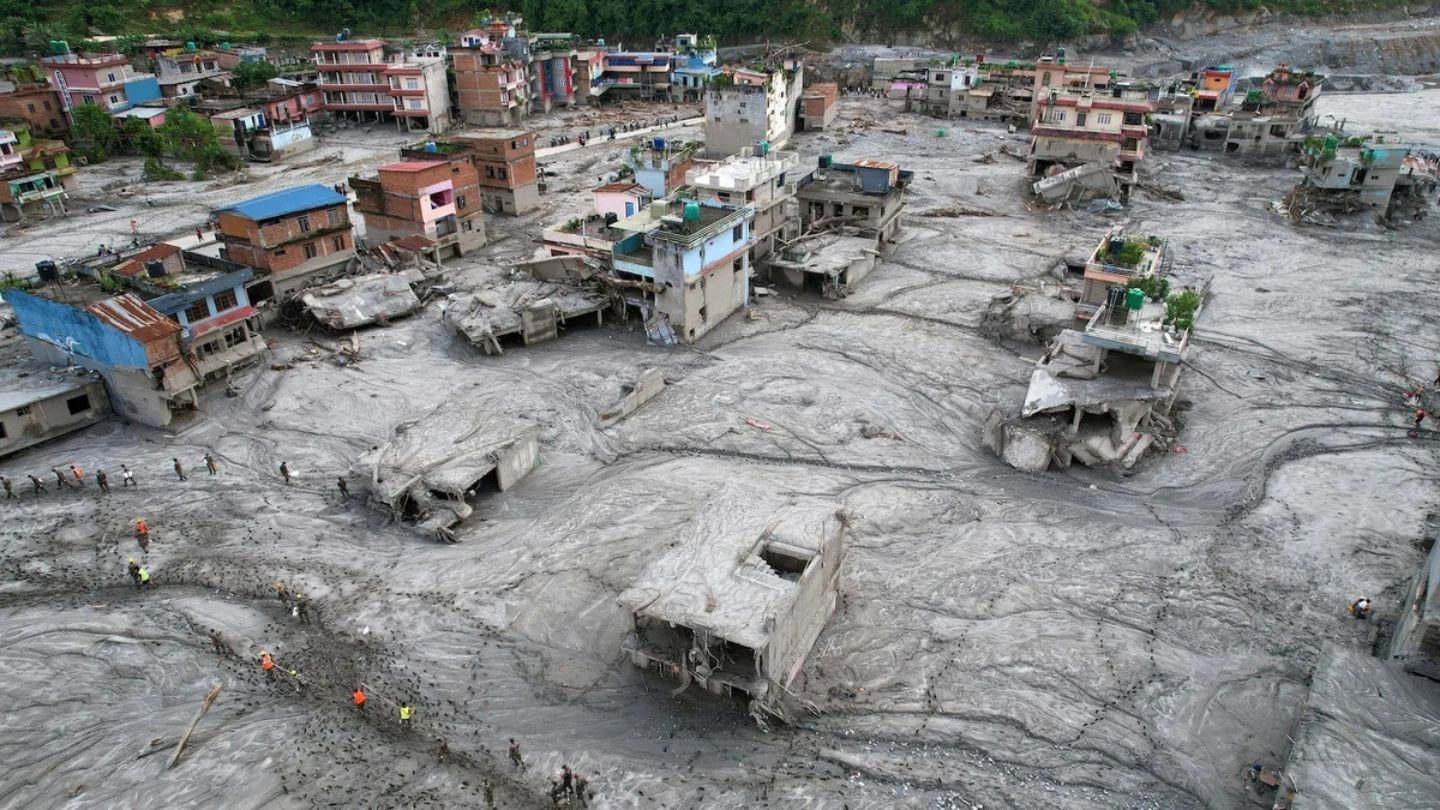
Nepal’s response to the catastrophic Lhende Khola-Bhotekoshi-Trishuli disaster in August 2026 marks an important shift in how climate disasters are understood. Rather than presenting the Himalayan catastrophe simply as a humanitarian disaster requiring charity, Kathmandu has emphasised its demand for climate justice and international climate finance, including grants for recovery, reconstruction, resettlement and addressing Loss and Damage.
As an Indian climate and ecological-justice activist who has consistently supported Nepal and other countries of the Global South in their struggle for climate justice, I strongly support this approach.
Those who have contributed least to global warming are increasingly suffering some of its most devastating consequences. Nepal’s contribution to historical global emissions is minuscule, yet its people face rapidly intensifying risks from glacier retreat, destabilising ice-rock systems, extreme precipitation, floods, landslides and glacial lake outburst floods.
The Bhotekoshi disaster is therefore not merely a Nepalese tragedy. It is a warning about the growing vulnerability of the Himalaya in a warming world.
Nepal’s demand should also remind us of Pakistan’s catastrophic floods of 2022. Around 33 million people were affected, while the World Bank-led assessment estimated more than $30 billion in damages and economic losses, with at least $16.3 billion required for reconstruction and rehabilitation.
Yet Pakistan contributes less than 1% of global greenhouse-gas emissions.
This is the fundamental injustice at the heart of the climate crisis: enormous human and economic losses are increasingly occurring in countries that did little to create the problem.
The same pattern is visible in climate-intensified cyclones and floods in poorer countries. Cyclone Idai devastated Mozambique, Malawi and Zimbabwe in 2019. Small island states and vulnerable African and Asian countries face repeated cyclones, storm surges, droughts and floods despite their negligible historical contribution to atmospheric greenhouse gases.
India too is increasingly experiencing this injustice—from devastating floods and extreme rainfall to Himalayan disasters, heatwaves, droughts and increasingly intense cyclones affecting coastal communities.
Climate justice must therefore be about rights, not charity.
But Nepal should be careful about identifying India as one of the principal historical culprit
There is, however, an important concern with any formulation that identifies India as a responsible country while failing to prominently distinguish between historically high-emitting industrialised countries and developing countries such as India.
The historical numbers are stark.
From 1850 to 2024, cumulative fossil-fuel and industrial CO₂ emissions were approximately :
| Country/region | Cumulative CO₂, 1850–2024 |
|---|---|
| United States | 434.9 Gt |
| EU-27 | 300.9 Gt |
| China | 285.1 Gt |
| Russia | 122.8 Gt |
| United Kingdom | 80.1 Gt |
| Japan | 69.6 Gt |
| India | 66.1 Gt |
| Canada | 35.6 Gt |
| Australia | ~20 Gt |
The global total is approximately 1.85 trillion tonnes.
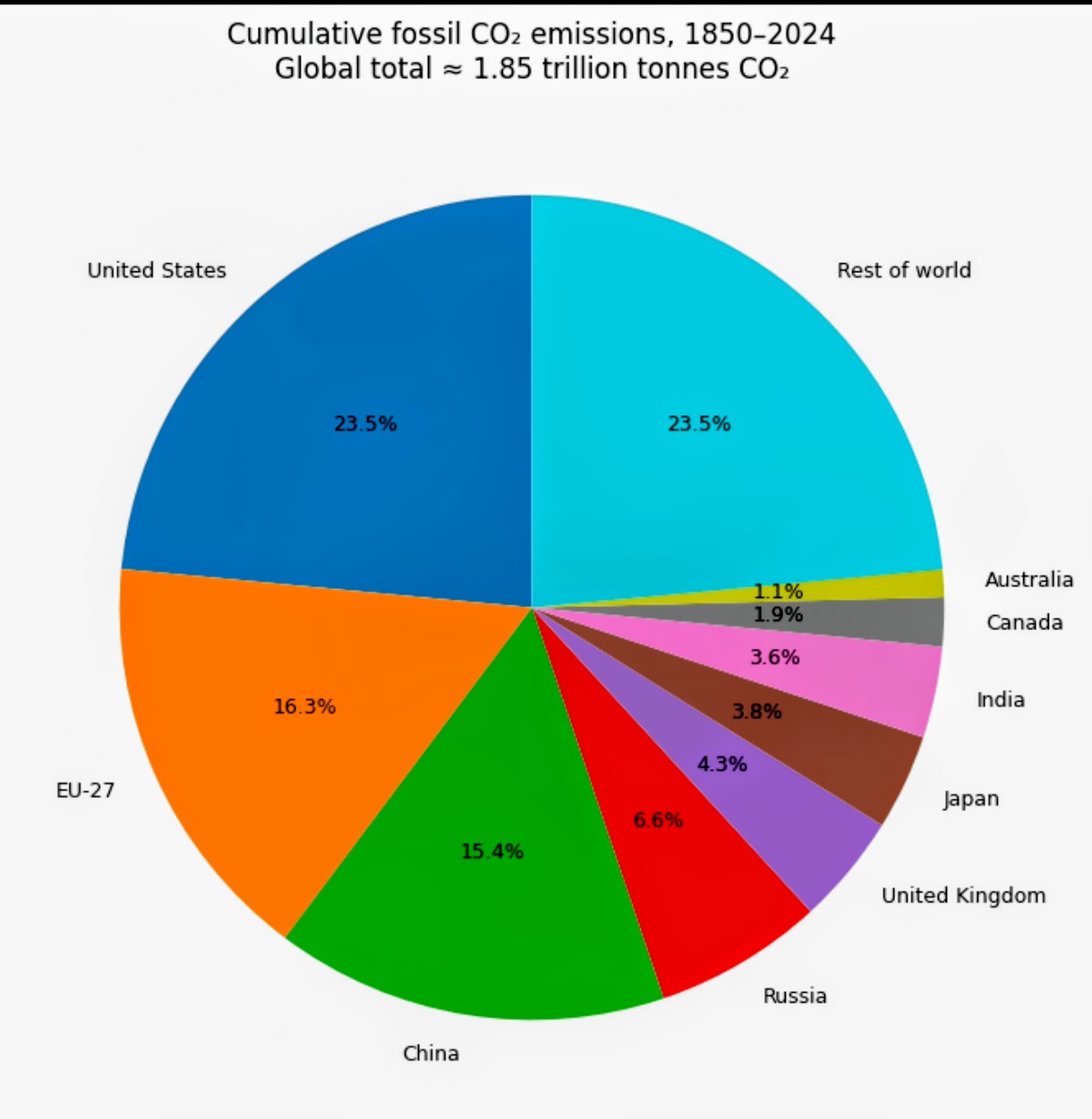
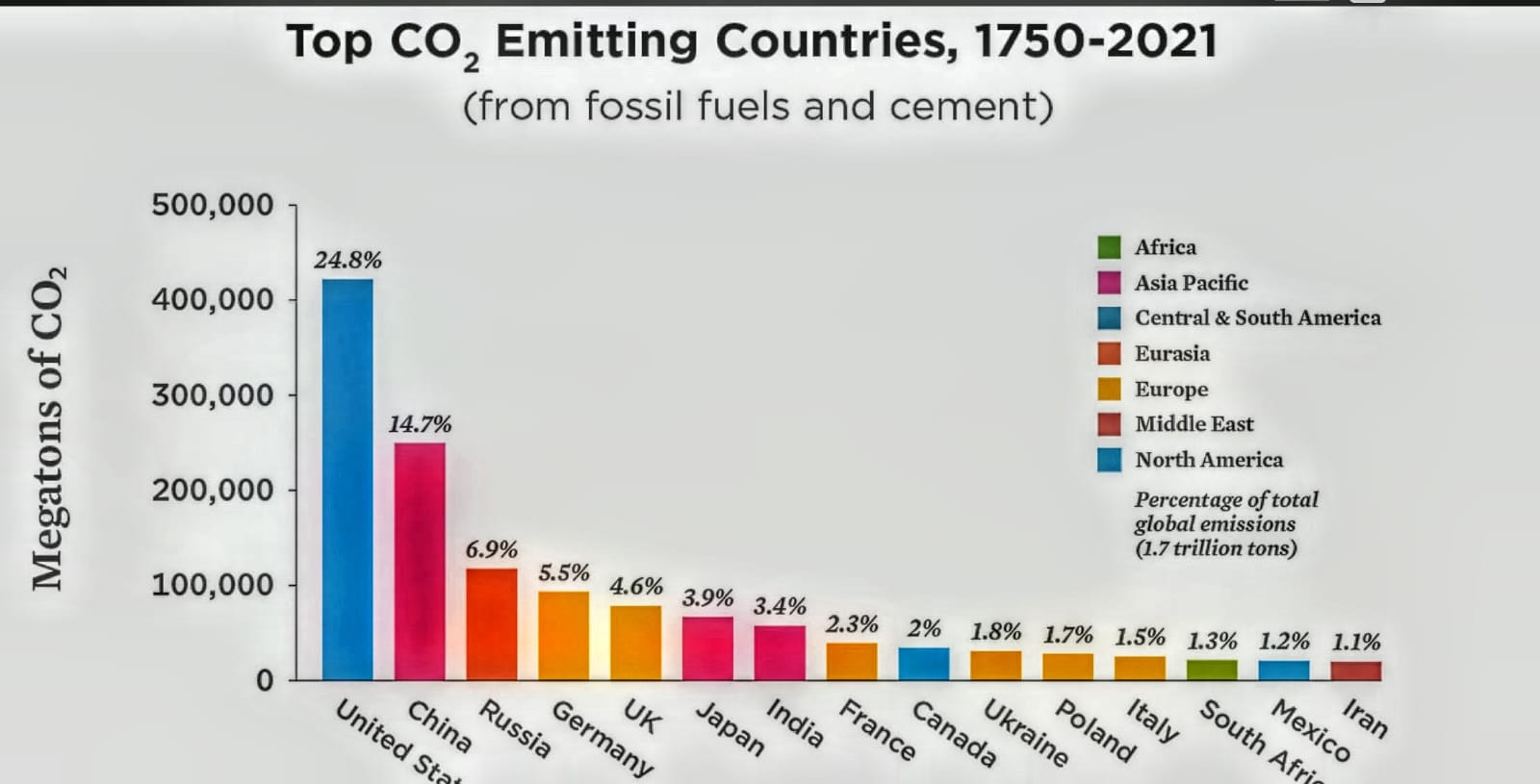
India’s cumulative contribution is therefore far below that of the United States and EU, despite India’s enormous population.
The contrast becomes even clearer when emissions are considered per person. India’s annual per-capita fossil CO₂ emissions are around 2.2 tonnes, compared with roughly 14 tonnes in the United States and Canada/Australia and more than 5 tonnes in the EU.
This does not mean India has no responsibility. India is now one of the world’s largest annual emitters in absolute terms, and its future development pathway matters enormously. But present-day gross emissions cannot be equated with historical responsibility.
Gross emissions alone cannot define climate responsibility
There is another fundamental problem with using only total national emissions. Imagine a country with a population of just a few hundred thousand people. It could have very high emissions per person but relatively small total emissions. Conversely, a country with more than a billion people may have large total emissions while having much lower emissions per person.
Could Bhutan, Maldives or another small country therefore simply point to Nepal’s larger gross emissions and declare Nepal responsible for climate change ?
Obviously not.
A meaningful framework for climate responsibility must consider historical cumulative emissions, present emissions, per-capita emissions, capacity to pay, development needs, consumption-based emissions and vulnerability.
That is why the principle of Common but Differentiated Responsibilities and Respective Capabilities (CBDR-RC) remains central to international climate politics.
The Global South should stand together
India should therefore not respond defensively to Nepal’s climate-justice demand.
Instead, India should say clearly :
Yes, Nepal deserves climate justice. Pakistan deserves climate justice. Bangladesh deserves climate justice. Small island states deserve climate justice. India’s vulnerable farmers, workers, coastal communities and Himalayan populations deserve climate justice. And historically high-emitting wealthy countries must provide substantially greater finance for adaptation and Loss and Damage.
The demand should be for new, additional, predictable and accessible climate finance, predominantly grants rather than loans, particularly for countries already burdened by climate disasters and debt.
Humanitarian assistance and climate finance should not be presented as alternatives. Emergency assistance saves lives today; adaptation finance reduces future vulnerability; Loss-and-Damage finance helps communities recover from impacts they could not reasonably prevent.
Nepal’s initiative therefore deserves strong solidarity from India.
But the political struggle should not become Nepal versus India, Pakistan versus India, or one vulnerable country against another.
The real issue is climate injustice.
The countries of the Global South—with their generally lower historical and per-capita emissions and enormous climate vulnerability—have a much stronger chance of securing a transformative global climate-finance agenda if they act together.
Nepal is right to demand climate justice. India should support that demand—not by accepting an inaccurate distribution of historical responsibility, but by joining Nepal, Pakistan, Bangladesh, African countries, small island states and other vulnerable nations in demanding that those who benefited most from the fossil-fuel era accept their greater responsibility.
Climate justice will be won through Global South solidarity, historical accountability and a fair transition—not by turning low-emitting and climate-vulnerable neighbours against one another.
References
1. Kathmandu Post — Nepal’s diplomatic push for international support after the Himalayan disaster.
2. Frontiers in Climate — Research on climate-induced loss and damage in Nepal.
3. World Bank — Pakistan Floods 2022: Post-Disaster Needs Assessment and reconstruction requirements.
4. IIT Gandhinagar / AGU — Scientific analysis of the extreme rainfall and flooding in Pakistan in 2022.
5. Natural Hazards and Earth System Sciences — Attribution research on Cyclone Idai and climate-change-related flood damage.
6. Global Carbon Project / Our World in Data — Cumulative CO₂ emissions, 1850–2024.
7. Our World in Data — Per-capita CO₂ emissions by country.
8. Global Carbon Budget 2025 — Friedlingstein et al., Earth System Science Data, historical and recent global CO₂ emissions.
9. Government of Nepal — Foreign Aid Mobilization Policy.
10. United Nations ECOSOC — Nepal’s statement on integrating humanitarian action, climate adaptation, disaster preparedness and climate finance.


