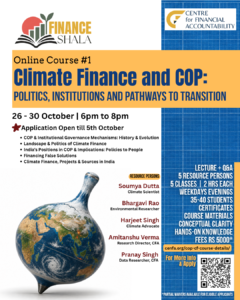
 Date: October 26–30, 2026 Time: 6:00–8:00 PM | Everyday
- Online | Zoom
- 30-35 participants per batch
- Fee: ₹5,000 (Partial waivers available for eligible candidates)
Apply here: https://forms.gle/yFTBtamZqWWx4u8o8 Session 1 — CoP & Institutional Governance Mechanisms: History & Evolution Course led by: Soumya Dutta on 26th October, 2026 (Monday).
Objective: Mapping the institutional and political architecture of global climate governance — the history and evolution of the CoP process, the role of bodies like the IPCC and UNFCCC, and the grant-making institutions that channel climate finance — alongside the political blocs (Global North vs. Global South, including especially vulnerable groups like Small Island Nations) that shape how negotiations play out.
Outcome: Participants will be able to name and distinguish the key institutions governing climate finance, trace how CoP evolved as a negotiating forum, and locate different blocs’ and lobbying groups’ positions within the broader politics of climate finance.
Bio: Soumya Dutta was formerly on the Advisory Board of the UN Climate Technology Centre & Network. He is a Trustee of MAUSAM (Movement for Advancing Understanding of Sustainability and Mutuality) and also serves as an Executive Member of Friends of the Earth India. He is also Senior Advisor with the Centre for Financial Accountability (CFA).
Session 2 — Landscape & Politics of Climate Finance Course led by: Harjeet Singh on 27th October, 2026 (Tuesday).
Objective: To build climate finance from first principles — what it means, how it emerged, and the politics of positionality behind it — covering its core components (adaptation, mitigation, loss & damage), the grants-vs-aid distinction, Nationally Determined Contributions (NDCs), and a climate justice lens for understanding who owes what to whom.
Outcome: Participants will understand what climate finance is, be able to distinguish its major components (adaptation, mitigation, loss & damage), and understand how loss-and-damage funds are actually procured and disbursed.
Bio: Harjeet Singh is a notable climate activist, who is also the founding director of Satat Sampada. He is actively involved in the activism space by serving as the strategic advisor at the Fossil Fuel Treaty Initiative, and the Global Policy Head at the Climate Action Network, alongside frequently lending his time and support for others initiatives, such as FinanceShala.
Session 3 — India’s Positions in CoP & Implications: Policies to People Course led by: Soumya Dutta on 28th October, 2026 (Wednesday).
Objective: To locate India’s specific position and interventions within the climate finance landscape and CoP negotiations — its Nationally Determined Contribution (NDC) commitments and performance against them, who within India is actually on the receiving end of this finance, and the need-assessment process behind it.
Outcome: Participants will be able to assess India’s performance against its NDCs, critically examine whether climate finance is distributed equitably once it reaches India, and identify the contradictions between India’s global negotiating stance and its domestic reality.
Bio: Soumya Dutta can be best described as a “people’s scientist”. An activist whose expertise of over three decades, spans across the energy sector, climate science, and ecological issues. Soumya da has been demystifying these concepts to us for a long time now, so it is our pleasure to now share the same wisdom with a larger audience.
Session 4 — Financing False Solutions Course led by: Bhargavi Rao on 29th Occtober, 2026 (Thursday).
Objective: To critically examine some of the proposed “green” pathways and analyse whether they count as investment in just transition.
Outcome: Participants will be able to recognoze greenwashing dressed as climate finance and evaluate what counts as genuine and what counts as false solutions.
Bio: Bhargavi S. Rao is an independent researcher, educator, and Senior Fellow and Trustee at the Environment Support Group with nearly 30 years of experience in law, policy, governance, and environmental and social justice. She has worked across research, advocacy, teaching, and legal interventions with organisations including Centre for Financial Accountability, Public Health Foundation of India, and Indian Institute of Science.
Session 5 — Climate Finance, Projects & Sources in India Course led by: Amitanshu Verma & Pranay Raj on 30th October, 2026 (Friday).
Objective: To examine the institutional sources of climate finance in India through concrete case studies — what projects are being funded, what contestations and challenges surround them — and build an accountability lens to ask whether this finance is actually serving its stated purpose.
Outcome: Participants will be able to identify institutional sources of climate finance in India, apply an accountability framework to specific projects, recognize signs of climate-washing, and know how and where to track this data (the “Datacorner”) and why it’s structured the way it is.
Bio: Amitanshu Verma is Research Director at Centre for Financial Accountability and has been working on critical issues pertaining to development finance, financiers, and the ecological cost of big infrastructure projects for over 4 years now. He has written extensively on the subject across various popular news media, and possesses the knack for simplifying these complex mechanisms.
Pranay Raj is trained as an economist and working as a data analyst at the Centre for Financial Accountability for over 4 years. He regularly makes sense of complex data and systems at CFA, and explains the underlying story as simply as possible, alongside writing extensively across popular news media.