
Date: 29th October to -1st November 2026
Development sounds like a “neutral” term, but in effect it’s one of the most contested ideas in modern history and so is the idea of development finance. When in history did “developed” and underdeveloped” become the buzzwords? What’s the politics of these words, and what’s the economics? Who finances what development, and towards what end, has shaped the lives of millions across the world, particularly the global South where the fate and trajectory of development has been the preoccupation of big finance. From World Bank to national Development Financial Institutions or DFIs; from commercial banks to pension funds; from bilateral investments to multinational development banks – there are different players in this field and each have their own political economy. Each has implications on people’s lives, livelihoods, climate and ecology. With the push for capital expenditure in the union budget, the question of priorities (social or capital infrastructure) also ought to be debated. Why are government school infrastructure being neglected, midday meal schemes underfunded and a myriad of other welfare schemes not implemented at the cost of mega highways, newer airports, freight corridors, etc.?
From the struggles of the adivasi people of the Narmada Valley to the fishworkers taking IFC to Supreme Court; from the people in the Himalayas standing up to indiscriminate hydel pressure on its rivers to the farmers at the receiving end of mega solar parks – the narratives of development and its financiers have often been challenged. They have often thrown up fundamental questions about who needs energy and how much; who benefits from port-led development and at whose cost; why the global north is interested in financing only one form of development and not another; are the financiers of development climate responsive; is financing in the name of climate crisis meaningful? Does our idea of development further marginalise those at the margins; is sustainability a serious concern in development discourse yet. These are all difficult questions, but ones that must be grappled with. After all, we cannot finance displacement, destruction and doom, in the name of development; we cannot allow the financialisation of every ounce of our lifeworld for profit. The workshop will attempt to unravel some of these questions and also grapple with ideas that can make finance more accountable. Towards this end, we will look into not only institutions and sectors, but also gain hands-on knowledge in reading investment data and understand the regulatory landscape.
Sign up if you are interested in the ways money and power shape the landscape of development and how the so-called dispensables, the people, resist and reshape. Join us if accountability for big finance and the financialisation of resources bothers you.
Program Outline
Day 1: Introduction to Infrastucture Financing
- Why does Finance Matter?
- World Bank, MDBs & The global Order of Finance
- The History & Politics of Financing Development: The changing landscape of Development Finance Institutions
- The union budget and the Capex push: Social infra vs Capital infra
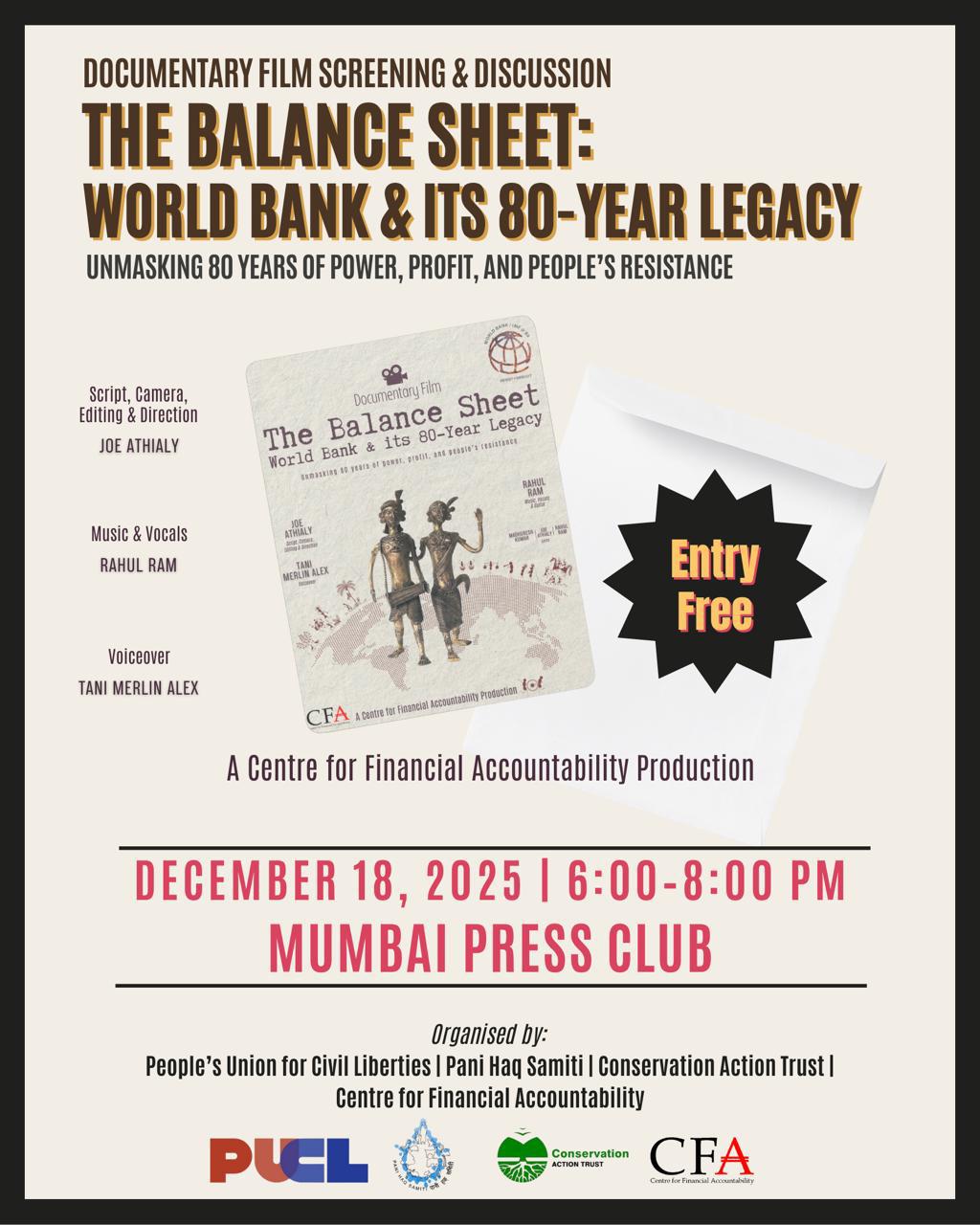
- Documentary: World Bank@80
Day 2: Sectoral Insights
- Financing Renewables: HYDEL
- Financing Renewables: SOLAR
- Rationale | Impact (Livelihood, Environmental) | Regulatory Loopholes | Ethical Blindspots | Financial Footprints
Day 3: Sectoral Insights (Contd)
- Climate & Finance
- What kind of Development Financing is done without consideration for climate crisis (Port, Coastal Projects, Himalayan projects, etc)
- What Development Financing is happening in the name of climate crisis: Are they adequate, well-directed or greenwashing?
Reading Financial/Investment Data
- Project Financing (databases)
- Lack of Transparency/Accountability
- Finance Data Corner
Sharing of Project Topics for Group Presentation
Day 4: Emerging Fields for Finance: Data Centres
- Rationale | Impact | Regulatory Loopholes | Ethical Blindspots | Financial Footprints
- Presentations by the participants
- Closing circle and feedback
Methodology:
The sessions will be non-technical; they’ll be taken by researchers, civil society leaders, and activists. Through a combination of expert lectures, interactive sessions, and group work, we will discuss the history, reforms, and impact of the issues related to the above-mentioned themes. Sessions will be followed by Q&A sessions and discussions.
Who is this workshop for
This workshop is designed for activists, students, and groups to understand the nuances of India’s public finance and its profound impact on social well-being. This workshop is also helpful for professionals, policymakers, researchers, or anyone keen on understanding the challenges of India’s financial landscape.
Program Schedule: Click here for the detailed schedule.
Language: The primary medium of instruction will be in English.
Resource persons:
Joe Athialy: Joe has nearly three decades of experience in grassroots work, national and international campaigns, and advocacy work, and is an avid campaigner for the accountability of financial institutions. He worked at the Narmada Bachao Andolon, a grassroots mass organisation working on issues of large hydro projects; the National Alliance of People’s Movements, a platform of mass organisations in India; Amnesty International and Bank Information Centre in various senior roles. Currently, he is heading the Centre for Financial Accountability, a Delhi-based research and campaign organisation on matters related to the national and international economy, and financial institutions. He is on the Board of Recourse, Focus on Global South India, and Environment Support Group. He has written and published several articles and reports in mainstream newspapers and other publications.
Soumya Datta: Soumya is associated with the environmental movement of India and is a key coordinator of MAUSAM (Movement for Advancing Understanding on Sustainability And Mutuality) and Friends of the Earth, India. He is also the co-convener of the South Asian People’s Action on Climate Crisis (SAPACC), a board member of GreenpeaceIndia Environment Trust, and a founding member of India-Climate-Justice (ICJ).
Nancy Pathak: Nancy is a researcher, the National Finance team at the Centre for Financial Accountability. She has been associated with movements demanding social rights and adequate welfare spending.
Amitanshu Verma: Amitanshu is a researcher with the Center for Financial Accountability (CFA), where he critically examines how India’s financial system serves elite interests while sidelining ecology, social justice, and inclusive development. He has worked on topics such as banking practices, climate risk in infrastructure finance, and environmental and social safeguards in financial institutions. His work bridges research and public commentary, calling for transparency and accountability in finance to become central to policy and development debates—not just add-ons to them.
Anirban Bhattacharya: Team lead, National Finance team, Centre for Financial Accountability (CFA). Engages with concerns around inequality and democratic rights.
Bhargavi S. Rao: Bhargavi is an independent researcher, educator, and Senior Fellow and Trustee at the Environment Support Group with nearly 30 years of experience in law, policy, governance, and environmental and social justice. She has worked across research, advocacy, teaching, and legal interventions with organisations including Centre for Financial Accountability, Public Health Foundation of India, and Indian Institute of Science. Her research focuses on governance, public finance, urbanisation, livelihoods, and environmental decision making, and she has taught with institutions in India and internationally.
Pranay Raj: Pranay is an economist and Data Team Lead at the Centre for Financial Accountability (CFA). His work focuses on building and managing public finance and climate finance databases, analysing complex datasets, and translating data into accessible insights for research and advocacy. His areas of interest include climate finance, public finance, energy transitions, development economics, and data visualisation.
Participant Contribution
We hope that participants will contribute an amount of Rs. 5,000/- towards workshop expenses, inclusive of all on-site workshop costs: boarding, lodging, and all the materials used in the workshop. Travel of participants will have to be borne by the participants.
Do not let money be an impediment to your application. Need based fee waivers are available. We have a limited number of scholarships so please apply for a fee waiver if you really need it. Do remember that there may be others who need it more than you.
How to reach: Please visit Getting here
For any other info: WhatsApp or call : 889 422 7954 (between 10 am to 5 pm), or e-mail: programs@sambhaavnaa.org
To register for the workshop, please fill out this Google form.