 On 26th August 2026, an ice-rock avalanche near the Nepal-Tibet border wreaked havoc across vast regions of Northern and Central Nepal. By September 10 2026, the death toll had risen to 1377, with over 5000 people missing, and immeasurable damage to land and property. Climate scientists have opined that rising temperatures due to global heating has left the Himalayas vulnerable to Glacial Lake Outburst Floods (GLOFs), incessant landslides and debris flows. We have seen the same in the devastating Sikkim flood in 2023.
According to the World Bank Group’s Country Climate and Development Report for Nepal, the country’s contribution to the global GHG stock is almost negligible, standing at 0.1%. The question thereafter is that if a country like Nepal which has played almost no role in accentuating the pan-national climate crisis, then why must it stand at the frontiers to bear one of its most devastating brunts?
Those are some of the questions that are supposed to be discussed and debated in international bodies like the COP.
As we know, COP31 approaches us fast and is to be held in Antalya, Türkiye between 9th to 20th November. While the common rhetoric for COP is usually how the world comes together as one to solve the issue of the climate crisis, this framing obscures an uncomfortable truth. The global north, which has historically been responsible for contributing largely to the emissions stock, is also the entity which unilaterally sets the agenda, timeline, commitments, and technological frameworks to solve the crisis which it has disproportionately contributed to.
This essentially means that the global south, which bears the least historical responsibility for the climate crisis, is left to bear the brunt of the consequences. It is unfairly asked to negotiate within a structure, which it had little handle in designing, accept timelines regulated to the priorities and capacities of industrialised economies, and adopt technological and financing solutions that often serve the interests of the very actors who created the problem in the first place. Even within a country, it is those in the wealthiest quantile whose carbon footprint is disproportionately high, while those at the bottom face the brunt of the floods, the cloud bursts, the heatwaves, forest fires, cyclones, landslides and so on.
What this campaign therefore aims to do is not just provide an entry point to understand what the institution of COP actually is, but to go beyond that to understand how COP acts as a site of contestation for dominance for who sets the narrative of how the climate crisis can be resolved. Every COP produces a set of commitments that will be lived out over the next three decades; by people who are, right now, sitting in classrooms. The students on your campus today will spend their working lives inside the climate scenarios being negotiated on their behalf, and will inherit whichever version of the climate transition that gets chosen.
They are not a future constituency. They are the stakeholders with the longest exposure and the least say Climate Heirs exists to close that gap. Rather than treating young people as an audience for climate awareness, the campaign treats them as participants in a live policy argument, one with real trade-offs, unresolved questions and no consensus answer.
This year’s COP lends its focus to four central themes:
- Zero Waste: With waste pollution being the third largest contributor to methane emissions which is responsible for 30% of global GHG emissions, the current waste ecosystem is structured fundamentally around an endless loop of extraction → production → disposal. A zero-waste formulation offers an alternative defined via a no burn, no bury, no toxics policy. It suggests a move away from false solutions such as Waste-to-Energy and unmitigated incineration.
- Oceans and Seas: Oceans and Seas capture 90% excess heat. Massive amounts of polluting discharges in the water have driven tremendous ocean acidification, marine heatwaves, and the depletion of coastal and marine ecosystems. While the official COP lends its focus heavily on blue carbon integration into climate accounting and NDCs to promote greater carbon sequestration via coastal ecosystems, the more pertinent question remains as to how are we to close the gap between the counting of such ecosystems on paper via-a-vis their actual preservation on ground.
- Food Security: Currently, 318 million people worldwide are facing acute food insecurity driven by climate shocks. However, food production itself has a massive impact on climate. In order to sustainably solve the food crisis, the issue cannot be delinked from the question of climate. Climate-resilient agriculture cannot be built by breaking the backs of small and marginal farmers who largely bear an inequitable cost of adaptation for food-production based climate crises.
- Climate-Resilient Cities: Cities are responsible for contributing to about 70% of the total emissions stock while absorbing some of the worst climate impacts back. Nearly 15% of major cities globally are increasingly becoming prone to extreme climate risks such as unbearable heat, flooding, or air pollution, to name a few. COP31’s framing to talk about this crisis is viz. green certification, low-carbon urban systems, etc. However, what has to be kept in mind, is how equitably the transitions to clean urban infrastructure can happen, so as to not trample upon the lives of those (people living in informal slums, the unhoused, daily wage workers, etc.) who are the worst impacted.
These four action items are not abstractions that negotiators will argue over in Türkiye while the remainder of the world watches; they are the terms on which waste gets managed in our neighbourhoods, coastlines get protected or sold off, farmers get credit or debt, and cities decide whose settlements are worth protecting. Climate Heirs takes these same fault lines and puts them in front of students directly, through four activities that move from argument to evidence.
Suggested Activities:
Intra-College Debate:
Format: parliamentary-style, two teams of three, 30-40 min per round.
Three suggested motions, one per round/choose any one out of the three:
Motion 1: “This House believes that developed countries should pay more for climate adaptation and mitigation because of their greater historical responsibility for the climate crisis.”
Motion 2: “This House believes zero waste is a production problem, not a consumer habit.”
Zero waste and circularity are among the defining themes of this year’s COP, and the fight is over where the obligation sits – with the person sorting their bin, or the company that designed something unsortable.
Motion 3: “This House believes that installation of air purifiers, sealed HVAC systems, indoor air quality certifications – are a resilience strategy for the rich, not a solution to air pollution.”
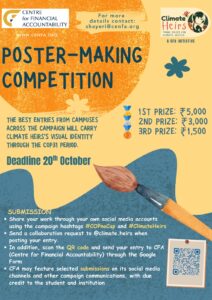
Poster-Making Competition
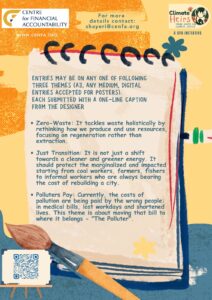
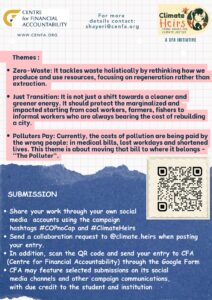
The best entries from campuses across the campaign will carry Climate Heirs’s visual identity through the COP31 period. Entries may be on any one of three themes (A3, any medium, digital entries accepted for posters), each submitted with a one-line caption from the designer:
On Zero-Waste
Zero waste rethinks how we produce and use resources, focusing on regeneration rather than extraction. It tackles waste holistically by considering a product’s entire lifecycle, not just its disposal. For this topic, we are interested in posters that name the system, not just the litterbug.
On Just Transition
A fair transition is not just a move from say from coal to solar. It protects coal workers and displaced farmers in the energy shift, and slum residents and informal workers being pushed out as cities rebuild themselves “green.” We are interested in posters which show who pays for the transition and who gets left outside it.
Polluters Pay
The costs of pollution are already being paid, just by the wrong people; in medical bills, lost workdays and shortened lives. This theme is about moving that bill to where it belongs.
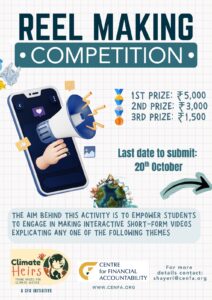
Reel-Making Competition
The aim behind this activity is to empower students to engage in making interactive short-form videos explicating any one of the following themes (same as in the case of poster-making):
- On Zero-Waste
- On Just Transition
- On Polluters Pay
Suggested Format:
- Length: 60-90 seconds (Instagram Reels/YouTube Shorts format, vertical 9:16)
- Language: English, Hindi, or any regional language (with English captions/subtitles if not in English)
- Style: Flexible- the produced reels can be in the format of a skit, voiceover explainer, on-campus vox-pop, stop-motion, meme-style edit, or straight-to-camera piece. No professional equipment required; phone footage is fine.
For both the poster-making competition and reel-making competition,
We will be sifting through all the entries which we receive, and prize money will be awarded to the top three entries in both categories.
All entries received from all participating colleges will be considered together for the competition. The three best entries submitted in the Poster-Making category and the three best entries submitted in the Reel-Making category will receive the respective prizes. The prizes will therefore not be awarded separately for each college.
The Prize money is set at 5000 for the person who comes first, 3000 who comes second and 1500 for the person who places third.
Sharing and Submitting Entries:
Students participating in the Poster-Making and Reel-Making competitions are encouraged to share their work through their own social media accounts using the campaign hashtags #COPnoCap and #ClimateHeirs. In addition, participants will be requested to send a collaboration request to the dedicated Climate Heirs Instagram page when posting their entries. This will allow the campaign page to function as a live, student-driven space where entries generated across participating campuses can be featured and circulated during the campaign and through the COP31 period.
Participating students will also be required to submit their entries directly to CFA through this Google Form. The form will collect basic participant details and allow students to upload their posters and reels for the CFA team to review and archive.
CFA may feature selected submissions on its social media channels and other campaign communications, with due credit to the student and institutions.
Film Screening and Discussion
Suggested titles, to be confirmed with the college:
- All That Breathes (a 2022 documentary film by Shaunak Sen)
- Invisible Demons (a 2021 documentary film by Rahul Jain)
- Katiyabaaz (a 2013 documentary film by Deepti Kakkar and Fahad Mustafa)
- 2040 (a 2019 documentary film by Damon Gameau)
- How to blow up a pipeline (a 2022 film by Daniel Goldhaber)
- The Illusion of Abundance (a 2022 documentary film by Erika González Ramírez and Matthieu Lietaert)
- The Story of Plastic (a 2019 documentary by Deia Schlosberg)
- No Impact Man (A 2009 documentary by Justin Schein, Laura Gabbert)
(CFA can facilitate access to the aforementioned movies and documentaries. Interested colleges can also reach out to us to arrange for a post-screening discussion on the movies).
Some requirements:
- A faculty coordinator as a point of contact
- Circulation of the call for entries to students
We would be glad to walk through any of this over a call, or to visit campuses that are located in Delhi. Please write back to us at shayeri@cenfa.org or call at 9073697976, and we will follow up with dates.
Posters: