
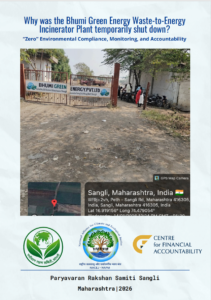
This fact-finding report examines the environmental compliance, monitoring practices, and impacts on agriculture and health of the Bhumi Green Energy Waste-to-Energy incinerator plant located in Tung village, Sangli district, Maharashtra. The report is based on documents obtained through the RTI Act, findings of the MPCB and CPCB, Agricultural Department Officials, and a field visit conducted by members of the Paryavaran Rakshan Samiti Sangli, National Alliance for Climate and Ecological Justice and project-affected villagers.
The report identifies extensive non-compliance with the environmental regulations and the conditions imposed under the plant’s Consent to Operate. The company failed to submit mandatory quarterly compliance reports, annual environmental statements, and dioxin-furan monitoring reports. It also failed to operate a functional Online Continuous Emission Monitoring System, limiting regulatory oversight and public transparency.
Official inspections by the MPCB in 2025 revealed untreated effluent was found stored in temporary lagoons and discharged into a nearby stream connected to the Warana River. The Effluent Treatment Plant was non-operational, while air pollution control systems such as the Electrostatic Precipitator were either not functioning or leaking, resulting in visible black emissions from the WTE plant. The MPCB’s inspection records pollutant deposition on nearby crops. These findings prompted the MPCB to issue show-cause notices and interim directions, which remained non compliant during subsequent inspections.
The CPCB also observed major operational deficiencies. The plant’s secondary combustion chamber was operating at approximately 230°C, far below the mandated 950°C required for safe incineration mandated by the Solid Waste Management Rules, 2026. Operating at such low temperatures will result in flue gas emissions which will contain much higher levels of pollutants such as carbon monoxide, volatile organic compounds, soot, acid gases, and carcinogenic dioxins and furans formed from incomplete combustion. Monitoring of fly ash, bottom ash, air emissions, and wastewater was found to be inadequate or absent, raising concerns regarding toxic emissions and hazardous waste management.
Evidence from the Agricultural Department’s report indicates that emissions and ash from the plant have affected surrounding agricultural activity. An Agricultural Officer’s report recorded deposition of ash on crop leaves within approximately 1– 1.5 kilometres of the plant, affecting photosynthesis, crop growth and agricultural yield.6
A later report from Sept 2026 by Agricultural Officer recorded that some farmers had left their agricultural land fallow, while others had shifted from grapes to sugarcane because of the perceived effects of pollution on crops. The report also refers to a conditional order issued by the Sub-Divisional Officer requiring the industry to control pollution and the risks posed to human health, agriculture and the environment.
This report documents a pattern of repeated regulatory violations dating back to 2023. MPCB directions from 2023 recorded failures relating to operation of water, and air-pollution control equipment, discharge of untreated effluent beyond the premises, exceedance of consented effluent standards, inadequate scientific storage of fly ash and dust emissions affecting nearby agricultural fields. A subsequent compliance report stated that the directions had not been complied with and that the industry had not submitted a response to the earlier directions.
Field observations and testimonies from villagers indicate significant environmental, health, and socio-economic impacts. Residents reported persistent foul odours, respiratory ailments, eye and skin irritation, and declining agricultural productivity. Farmers observed black particulate deposits on crops, livestock refusing contaminated fodder, and change in crop pattern from grapes and vegetables to less sensitive sugarcane cultivation. Waste spillages from transport vehicles and deterioration of local roads have further affected livelihoods. Bottom ash and rejected waste from the industry is being handed over to the private parties for the land-filling which raises serious concerns of soil and water contamination.
This report concludes that the Bhumi Green Energy plant demonstrates systemic failures in environmental compliance and accountability which has led to the temporary closure of the industry. It recommends immediate permanent shutdown of the facility, application of the polluter-pays principle, environmental restoration measures and compensation for the affected communities, and a policy shift towards decentralized, zero-waste alternatives emphasizing waste reduction, reuse, repair, recycling, and composting. The Sangli WTE case also serves as a warning against the establishment of new WTE plants in Mumbai, Pune, and other parts of Maharashtra, given the demonstrated risks of environmental pollution, public health, regulatory non-compliance and weak accountability
Read and Download the report here: Why was the Bhumi Green Energy Waste-to-Energy Incinerator Plant temporarily shut down?

