The World Bank and IMF Annual Meetings are under way in Bangkok, running from 12 to 18 October, and the agenda is a familiar one: debt, growth and “reform”. What rarely makes the agenda is who pays for it. Across the Global South, governments are spending more on debt repayment than on health, education or social protection, while the costs of climate change keep rising. Too often, the policies these institutions promote have pushed the burden of crisis onto ordinary people and protected creditors, corporations and powerful economies. The real question is not just how the global economy is managed, but who it serves and who gets to decide.
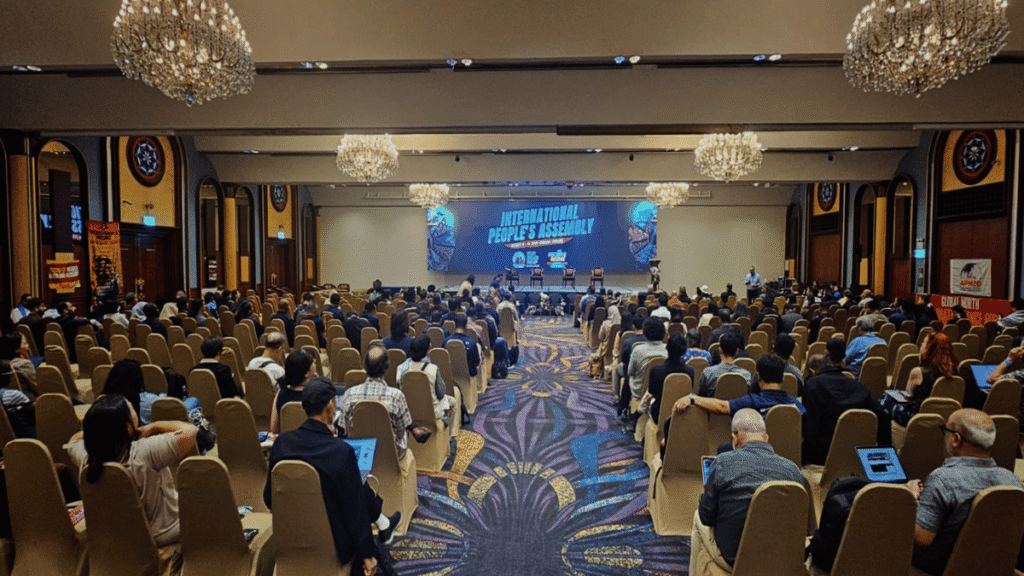
Outside the official halls, the International People’s Assembly, held in Bangkok on 12–13 October and coordinated by the Asian Peoples’ Movement on Debt and Development (APMDD), offered an answer. It brought together civil society organisations, trade unions and social movements to build shared strategies for economic, social and climate justice. Their demands are set out in the Asia Regional People’s Declaration 2026, adopted by 30 civil society networks and organisations after an online regional assembly on 1 October, which drew over 116 community members, CSO leaders and academics. It calls for:
- unconditional cancellation of external debts of low- and lower-middle-income countries
- an end to austerity and the privatisation of essential services
- publicly funded social protection
- accessible, grant-based climate finance
- democratic accountability in global financial governance
- protection of civic freedoms, and an end to war and militarism
The CFA team took part in several sessions at the Assembly. We also organised “Towards a World Downside Up: Unknotting the Iniquitous Rules of the World Bank”, with Jayati Ghosh, Ishmael Zulu, Joe Athialy and Anirban Bhattacharya. The discussion looked at how the Bank’s role deepens inequality, and at publicly funded, redistributive alternatives that put people’s needs before corporate profit.
The Assembly matters because no country can face debt distress, climate disasters and economic shocks alone, especially when the rules of global finance are written by unequal power. Communities across Asia, Africa and Latin America are living connected crises, and their struggles are connected too. Acting together lets them challenge dominant economies, demand accountability from international financial institutions, and make sure workers, farmers, Indigenous communities and women are heard in decisions that shape their lives. The test now is whether these demands travel beyond Bangkok and become sustained campaigns, public debate and political pressure. A fairer financial system will not come from the World Bank and IMF on their own. It will come from movements that organise across borders and insist on an economy built on democracy, public accountability and the needs of people and the planet.