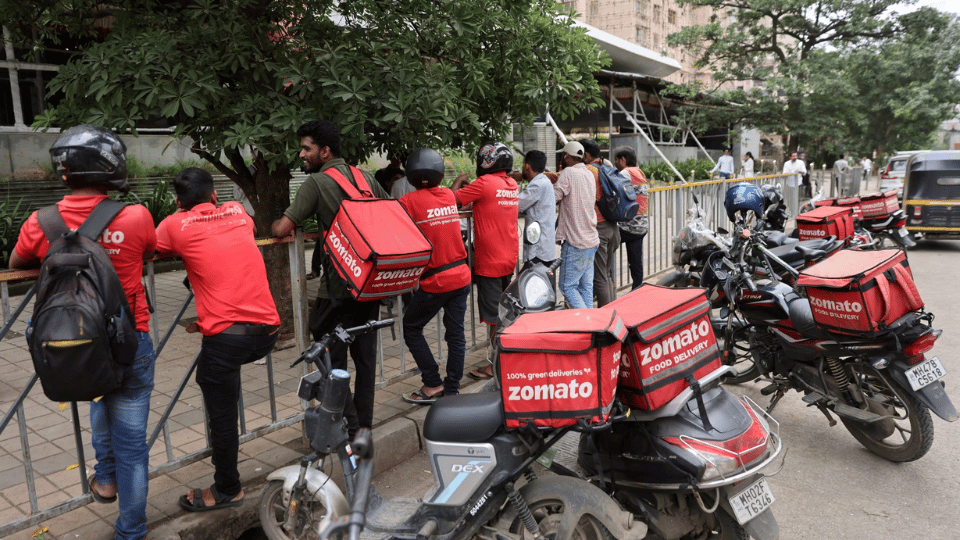
“Gig workers are told that they are free. But what sort of freedom is this that the worker themselves can’t seem to feel? The contractor claims that you are free. How banal is that! Does a jailer scream out loud every night reminding you that you are in jail? Prisoners know that very well right? They know that very well.”
Those are the words that are narrated before a song titled “Rating nahi Haq Chahie”. They stayed with me somewhere in my mind and resurfaced the day the GDP figure was launched with much fanfare. By now of course there has been enough debate on the number, 7.8% with serious questions being raised about the methodology, base year and so on. A dogged defense has also been mounted to back up the number. We won’t really get into that debate here. We would rather look at some government surveys that correspond to and report on the same quarter that has supposedly achieved the “herculean task” of reaching 7.8%. And one is left to wonder as to what is this growth that people can’t even seem to feel themselves.
First is the July Round of the Rural Economic Conditions and Sentiments Survey (RECSS) report that is released bimonthly. What it reveals is a picture that is rather grim. The survey finds that the proportion of rural households reporting an increase in income has exhibited a consistent decline since the November 2025 round, reaching 27.7% in July 2026 – “the lowest level recorded since the inception of the survey”. The share of households who reported no change in income was the highest, rising to 52.6% by July 2026 from 38.6% in September 2024. Given that this corresponds to the period when the war clouds got darker in the Gulf, elevating both fuel and fertilizer prices makes this shrinking of pockets more concerning.
Another red flag that the NABARD July Round raises is about the savings. The proportion of households reporting an increase in financial savings during the preceding year declined to 17.8% in the July 2026 round, the lowest level recorded since the inception of the survey. If that is about their outlook about their present, their sentiments about the future are no better. The proportion of households expecting improvements in both income and employment during the next quarter fell to its lowest level in the July Round since the inception of the survey. This doesn’t look like the sentiments of a people experiencing a phenomenal growth rate. Falling income, rising prices, dwindling savings, rise in informal credit – each of these is compounded by the fact in this latest round of the survey the proportion of households receiving no government transfers increased to 16%, the highest level observed in the surveys so far. The jury is out as to whether this is to be credited to “better targeting” or sheer apathy.
If we look at the rounds corresponding to Quarter one of yet another regular survey the sentiments look equally morose. The Forward Looking surveys released by the RBI in June again underlined that ordinary Indians are not really looking forward. Consumer confidence for the current period declined for the third successive round with the Current Situation Index (CSI) going down to 90.7 from 95.7 in the previous round. These are figures that factor in sentiments around economic situation, employment, income, spending and prices level.
Confidence for the year ahead also weakened from the previous round. The Future Expectations Index (FEI) dropped by 1.5 points to 118.7, the lowest since September 2023. Households’ current perception of the economic situation (as per RBI’s Consumer Confidence Survey) also receded, registering a further decrease of 7.9 points from the previous round. As expected, households’ sentiment weakened significantly particularly on discretionary expenditures which is not good news for domestic demand. This means that households are holding back on things like eating out, travel, electronics, apparel, etc, anything that is not essential. This has a direct fallout on growth and jobs.
Be it the workers’ protest across the National Capital Region in Noida or Gurgaon or the students and youth protests that rocked the streets of the capital and other cities, they tend to testify this frustration and disillusionment. Sadly, this is a reality that is far removed from the official euphoria around growth.