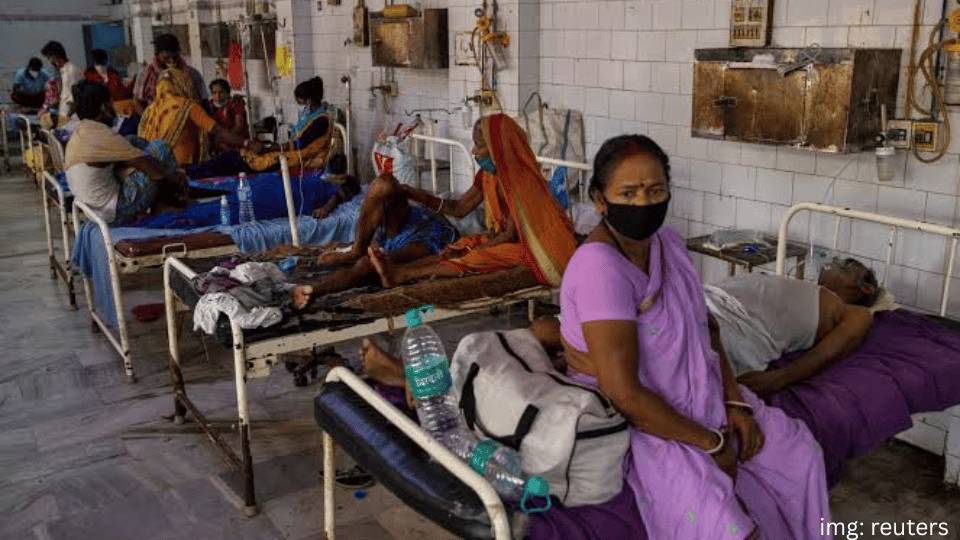
You may see a poor person in India in a Max hospital and feel ecstatic about our development path – that we have even lifted the poor into the world of sophisticated, private healthcare. But what you cannot see are the conditions that forced her to come there: the burden it places on her lean back and leaner purse, and the sacrifices she and her family have to make in desperation to treat a loved one. This is dire particularly at a time when the hospital itself is not merely a place of care but also an investment asset yielding returns.
I have had the privilege of spending a long, unusually long period of time, in the All India Institute of Medical Sciences Delhi OPD corridors. And there you can hear the effects of the financialisation of healthcare in murmurs. People having to come from hundreds of kilometers away because probably private players did not find those areas financially viable. For them the affordable and quality care that AIIMS provides is truly an oasis. People speaking in whispers about their family members waiting for their dear ones to just breathe their last in as little pain as possible, as healthcare would drive them into deeper debt.
The average out of pocket expenditure per hospitalisation is 6631 rupees in govt hospitals as compared to 50508 in the private. That is 7.6 times higher.
This is in continuum with the steps taken in the last decade or two of the last millenium when capital under neoliberalism was eager to turn each and every aspect of our lives into marketable and profitable ventures. In its 1987 policy paper, Financing Health Services in Developing Countries, the World Bank pushed curative healthcare as a private good that patients should pay for. The World Bank’s 1993 report “Investing in Health” prescribed health sector reforms for developing countries. Such prescriptions limited public healthcare services to a small arena while leaving the rest to the market. With that an essential aspect of our lives was turned into a matrix of “cost-effectiveness” – dollar spent per life. Doors were opened for foreign investments in healthcare with the express purpose of profiting from treating the elite in developing countries, the elite that abandoned the public health systems to disrepair and neglect.
The healthcare sector, in recent decades, has received heightened interest from investors (both venture capital and private equity). The growth in multi-specialty and single-specialty hospitals in the country has taken place mainly on their back. A flurry of investments happened post the year 2000 when India allowed 100% FDI in the hospital sector. The jump in the value of merger and acquisition deals in hospitals also attest to this story.
While the market prescriptions often came in the name of “efficiency”, but, healthcare driven by private equity can never limit inappropriate and wasteful use. Public health experts have raised concerns that insurance schemes may inadvertently encourage procedural interventions in private facilities. Publicly funded health insurance can simply become a vehicle for channeling public funds towards purchasing healthcare from private providers who may be constantly looking to better their valuation. After all, when private equity enters healthcare, a hospital is measured increasingly in terms of revenues, margins, valuations and returns than the social purpose of healthcare and equity.
The other grip of financialisation that patients are forced into, is debt.
In late June, the Reserve Bank of India (RBI) released the Financial Stability Report (FSR), which underlined that India’s household debt stood at 45.5% of its gross domestic product (GDP). Worryingly, the figure is spurred largely by non-housing retail loans.
A micro-study that the Centre for Financial Accountability conducted in Nagercoil, Tamil Nadu, found that a large share of women were taking micro-credit to meet expenses related to education (55%) and health (47%). These are loans not for durable assets or for investment in businesses, which may generate income in the future. Instead, they are primarily consumption loans and a fair share is to incur health expenses.
The trappings of the neoliberal consensus that has produced this debt trap are visible across every aspect of our lives.
A recent study by TransUnion CIBIL shows that the share of over-leveraged consumers rose threefold from 2016-17 to 2023-24. The problem of excessive borrowing is concentrated largely among younger borrowers, who have also been the fastest-growing segment of India’s retail credit market. Among the over-leveraged, their share increased from 8% in 2017 to 20% in 2026.
Rural India has turned into a predatory lending landscape for Non Banking Financial Companies even as the RBI has repeatedly been warning them of usurious lending practices and rates. Farmers are left at the mercy of both the market and the climate. And eventually in debt. The landless oppressed castes would find themselves most exposed.
Microfinance, as pointed out by the last Economic Survey of the government is also showing signs of over-indebtenedness. What was initially conceptualised as a model that aimed to improve household resilience, over time became integrated into capital markets, said the Economic Survey. Their operating environment increasingly reflecting the incentives associated with growth-oriented commercial investment. This is financialisation of poverty and atomisation of individuals who are blamed for their own poverty, rather than raising structural reasons.
Now, infrastructure. Earlier it was treated as a public good. The starting question thereby was what infrastructure does the country need for its long-term development? Planning, public investment and development finance institutions then worked together to mobilise finance towards those priorities.
Under financialisation, the question increasingly became: which projects are financially viable and can yield returns? Banks, bonds, private investors, PPPs and institutional investors then became important sources of finance.
Policy prescriptions in this phase thereby downplayed the role of having our own development finance institutions. They were considered relics of a past when state “interference” was high. The IDBIs, HDFCs or IFCIs ceased to exist as DFIs. The difference was substantive.
With financialisation of infrastructure, projects that cannot easily extract user fees or yield returns (such as rural transit or basic sanitation) is systematically sidelined in favour of say a toll expressway or privatised port. Even now that DFI has returned in policy discourse, it is only as a de-risker. To socialise the losses and privatise the profits.
Look at higher education as another sector. Students are increasingly forced to self-finance their education through loans committing their future earnings for repayment, the risk is consequently shifted from the education system to the student and household. Access to education shifts from being a matter of right to who can access and service debt. Education becomes a commodity and to purchase a better commodity one has to take higher loans.
Even social security for old age today is heavily financialised. Guaranteed pension plans have given way to private pension plans, or market-linked mutual funds that profit from our uncertainties. The financial risk of aging is transferred entirely onto the individual as they fend for themselves exposed to stock market crashes and market volatility at an age when they are most vulnerable.
Cumulatively as financialization pervades through where we live, where we study, where we heal to where we work, life is reduced to precarity that feeds private profiteering. Today’s needs are increasingly met through claims on tomorrow’s income.
The corporates who have benefitted from this financialisation are today largely directing their profits once again to speculative markets instead of investing in infrastructure, decent jobs or wages further widening inequality.