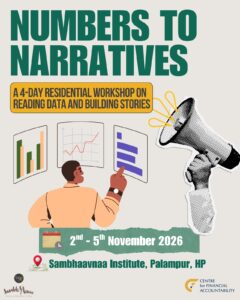
4-Day Residential Workshop
Dates: 2nd to 5th November 2026
Background
What happens on the ground often leaves a trail in the paperwork. Money that does not reach a village, a river polluted by a corporation, or a welfare scheme that fails its beneficiaries can all be traced through official records. The evidence of power’s failures is hiding in plain sight, in public databases, government portals and corporate filings that are technically open to everyone but practically accessible to very few.
This is not accidental. Complexity is a barrier. Jargon is a barrier. The sheer volume of data, combined with the lack of anyone to teach you how to read it, is a barrier. As a result, the people with the most at stake, the activist on the ground, the community worker in the field, the organiser building a case against a corporation or a government, are often the least equipped to use the evidence that already exists.
About the Workshop
Numbers to Narratives is a four-day residential workshop that introduces journalists, researchers and CSO/NGO professionals to practical tools for finding, reading and investigating stories through data and documents. The workshop focuses on developing the skills needed to work with government records, budgets, public data and corporate filings, and on turning this material into meaningful questions and stories.
The workshop pays particular attention to investigations involving government, corporations and climate, tracing how policies, projects and corporate activities affect communities and the environment. Through sessions with field experts, hands-on exercises and open conversations, participants will build a systematic approach to asking questions, finding evidence, verifying information and building stories that connect data to lived experience.
Objectives:
- Introduce participants to the changing media landscape in India and the structures of ownership and control that shapes it.
- Build practical skills in reading and investigating government budgets, documents and public data
- Strengthen the ability to investigate corporations through documents, filings and data
- Develop an understanding of development finance, multilateral development banks and how big money shapes policy and reporting
- Explore how to build human-angle stories that bring data and documents to life
- Provide hands-on training in data visualisation for storytelling
Who Should Apply
- Journalists and independent reporters covering finance, economy, environment or governance
- Researchers working on corporate accountability, climate and development finance
- Professionals from civil society organisations and NGOs
Methodology
A four-day, in-person, residential workshop combining expert-led sessions, practical exercises and informal conversation. Participants are expected to attend for the full duration.
Language:
English
Resource persons:
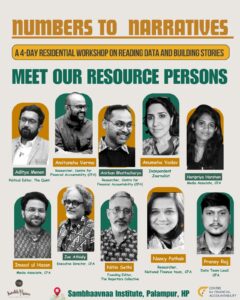
- Adiya Menon: Aditya Menon has been a journalist for over 15 years, having worked with leading media houses such as the India Today Group, Rajasthan Patrika and NDTV. Presently, he’s Editor (Politics) at The Quint, where he leads a team of reporters focusing on politics, institutions, livelihood and violence. His own reportage focuses on national and regional politics, communalism, caste and election data.
- Nitin Sethi: Nitin is a journalist and trustee of The Reporters Collective Trust. He is also visiting faculty at Ashoka University. He has written, reported and investigated for two decades on the intersections of India’s political economy, natural resources, environment, climate change, economy, public finance and development. His reportage has won several awards, including the Asian College of Journalism’s award for investigative journalism and the Prem Bhatia award for environmental journalism.
- Anumeha Yadav: Anumeha Yadav is an independent journalist reporting on the struggles of working-class and economically disadvantaged communities in India. Her reporting focuses on questions related to labor and land rights, and social welfare, often highlighting how government initiatives impact rural and marginalized groups. Yadav has investigated subjects such as the Aadhaar biometric system’s effects on social welfare programs, workplace rights, access to food and health care in conflict zones.
- Nancy Pathak: Nancy is a researcher, the National Finance team at the Centre for Financial Accountability. She has been associated with movements demanding social rights and adequate welfare spending.
- Joe Athialy: Joe has nearly three decades of experience in grassroots work, national and international campaigns, and advocacy work, and is an avid campaigner for the accountability of financial institutions. He worked at the Narmada Bachao Andolon, a grassroots mass organisation working on issues of large hydro projects; the National Alliance of People’s Movements, a platform of mass organisations in India; Amnesty International and Bank Information Centre in various senior roles.r the accountability of financial institutions.
- Pranay Raj: Pranay is an economist and Data Team Lead at the Centre for Financial Accountability (CFA). His work focuses on building and managing public finance and climate finance databases, analysing complex datasets, and translating data into accessible insights for research and advocacy. His areas of interest include climate finance, public finance, energy transitions, development economics, and data visualisation.
- Anirban Bhattacharya: Team lead, National Finance team, Centre for Financial Accountability (CFA). Engages with concerns around inequality and democratic rights.
- Amitanshu Verma: Amitanshu is a researcher with the Center for Financial Accountability (CFA), where he critically examines how India’s financial system serves elite interests while sidelining ecology, social justice, and inclusive development. He has worked on topics such as banking practices, climate risk in infrastructure finance, and environmental and social safeguards in financial institutions.
- Haripriya Harshan:Haripriya is the Media and Communication Associate at the Centre for Financial Accountability. She has over five years of experience working in the media and communications space, focusing on public finance and accountability. She holds a postgraduate degree in Mass Communication from Jamia Millia Islamia Central University.
- Imaad ul Hasan: He is a Media and Communication Associate at the Centre for Financial Accountability. He has made documentary films and written on the themes of human rights and political economy. His multimedia journalism and audio-visual work explore civil liberties, urban development, and socio-economic dynamics across India.
Workshop Details:
Dates and Venue: 2nd to 5th November 2026. Sambhaavanaa Institute, Palampur, Himachal Pradesh
● Duration: 4 days, residential
● Eligibility: Journalists, researchers, and civil society organizations, media & communications professionals
● Seats Limited: selection based on application
Participant Contribution
We hope that participants will contribute an amount of Rs. 5,000/- towards workshop expenses, inclusive of all on-site workshop costs: boarding, lodging, and all the materials used in the workshop. Travel of participants will have to be borne by the participants.
Do not let money be an impediment to your application. Need-based fee waivers are available. We have a limited number of scholarships, so please apply for a fee waiver if you really need it. Do remember that there may be others who need it more than you.
How to reach: Please visit Getting here
For any other info: WhatsApp or call 889 422 7954 (between 10 am and 5 pm), or e-mail programs@sambhaavnaa.org.
How to Apply
Interested candidates should submit a short application. Shortlisted applicants will be notified and asked to complete registration, including payment of the registration fee, ahead of the workshop dates.